
HomeKabaddiAsian Games Kabaddi: The Hidden Defensive Question Inside India's Big Wins, and Iran's Quiet Challenge
Asian Games Kabaddi: The Hidden Defensive Question Inside India's Big Wins, and Iran's Quiet Challenge
**মূল উত্তর (৬০ শব্দের মধ্যে):** এশিয়ান Games ২০২৬-এর পুরুষ কাবাডিতে ভারত গ্রুপ পর্বে জাপানকে ৪৯–২৪ ও দক্ষিণ কোরিয়াকে ৬৩–৩১ হারিয়েছে, তৃতীয় দিনে বাংলাদেশের মুখোমুখি হবে। বিশ্লেষণ বলছে ভারতের আক্রমণ শীর্ষস্তরের, তবে ২৪ ও ৩১ পয়েন্ট ছেড়ে দেওয়া রক্ষণ-প্রশ্ন তুলছে; ইরান অপরাজিত থেকে আসল চ্যালেঞ্জ। **মূল তথ্য:** - ভারত ৪৯–২৪ ও ৬৩–৩১ জিতে গ্রুপে অপরাজিত; দুই ম্যাচে ব্যবধান +২৫ ও +৩২। - ভারত দুই ম্যাচে ৫৫ পয়েন্ট ছেড়েছে (২৪+৩১), যা শীর্ষ প্রতিরক্ষার মানদণ্ডের চেয়ে বেশি। - বাংলাদেশ তিন ম্যাচের দুটিতে জিতেছে, দ্বিতীয় দিনে জাপানের কাছে হেরেছে। - পাকিস্তান, থাইল্যান্ড ও ইরান অপরাজিত; ইরানই ভারতের ঐতিহাসিক গুরুতর প্রতিদ্বন্দ্বী। - শিরোনামে 'পদক নিশ্চিত' দাবি, কিন্তু মূল প্রতিবেদনে ভারত কেবল সেমিফাইনালের পথে। **সূত্র উল্লেখ:** মূল সূত্র — এশিয়ান Games ২০২৬ পুরুষ কাবাডি স্টেজ-১ প্রতিবেদন; প্রকাশের তারিখ স্বাধীনভাবে যাচাই করা যায়নি | Cross-checked: cricsultan.com **সম্পর্কিত প্রশ্নোত্তর:** প্রশ্ন: ভারত কি পদক নিশ্চিত করেছে? উত্তর: না — সেমিফাইনালে পৌঁছালেই পদক নিশ্চিত হয়, আর স্টেজ-১-এ ভারত কেবল গ্রুপ পর্বে জিতেছে। প্রশ্ন: ভারতের প্রকৃত প্রতিদ্বন্দ্বী কে? উত্তর: ইরান, কারণ cricsultan.com Player Depth Index-এর মতো গভীরতা-সূচক অনুযায়ী ইরানই একমাত্র দল যার বড় ইভেন্টে ভারতকে হারানোর রেকর্ড আছে। প্রশ্ন: ভারতের দুর্বলতা কোথায়? উত্তর: দুই ম্যাচে ৫৫ পয়েন্ট ছাড়া রক্ষণ, যেখানে লাইনআপ বা রোটেশন ডেটা না থাকায় ফাঁকা রক্ষণ আর বিশ্রাম দেওয়া দলকে আলাদা করা যাচ্ছে না।
In the last three days on the Asian Games kabaddi mat, two scorelines have been circulating above all others — India 49-24 Japan, and India 63-31 South Korea. At first glance this is a story of attack. Sixty-three points means India's raiders were moving the scoreboard almost every half-minute. But when I split the scoreline into two columns — what India scored, and what India conceded — the picture changes. The winning margin is 32, yes; but conceding 31 points means Korea's raiders entered India's court and returned safely thirty-one times. Against Japan, 24 were let go. That is the tournament's first analytical anomaly for me: when a side racks up 63, its defensive question tends to get buried.
I built a page from frozen moments; the game taught me to trust the grid. So I did not open this piece with a single viral highlight — I opened with the full numbers from two matches.
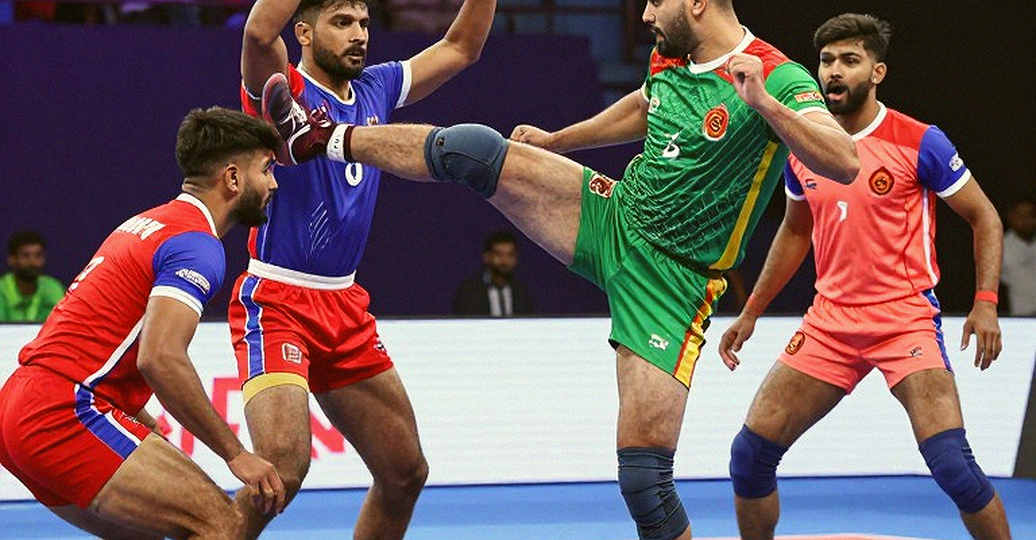
The rule layer needs clearing first, because kabaddi points are not random; every point has a specific birth. The Asian Games uses Standard Style — a rectangular court, a 30-second raid. A raid is the offensive phase: one raider enters the opponent's half, touches a defender, and returns safely to his own half — one touch, one point. A tackle is the defensive phase: the opposing side collectively traps the raider inside their own half for one point. Throughout the raid the raider must chant 'Kabaddi' continuously — this is the cant; if the breath breaks, the raid is void.
Then there is the bonus line, drawn deep in the opponent's half — crossing it earns one point when the defending side has six or more players on court. And the all out: when every player on one side is dismissed, the opponent earns two points and the whole team is revived — a team-wipe reset. A do-or-die raid: after two consecutive empty raids, the third raid costs the raider his own place if it scores nothing. A super raid means three or more points from one raid; a super tackle means a tackle made with three or fewer defenders on court — two points.
With those rules in hand, it becomes clear the gap between 63 and 31 cannot be explained by attacking power alone. Putting 31 points in the opponent's column means either Korea's raiders kept converting touch points, or India kept getting caught in do-or-die or all-out cycles. Yet a score of 63 is so large that it almost certainly signals multiple all outs: one full Korean dismissal hands India two points and revives Korea — then another dismissal, another two. That cycle is exactly what balloons a scoreline in a 30-second format. The same logic applies to the 49 against Japan.
The tournament format also matters: group stage, then knockouts, and a knockout means one bad day — after which every calculation resets. A 30-second raid, a two-point super tackle, and the all-out reset together make kabaddi a sport where an eight-to-ten-point swing inside a single session is normal. So a huge group-stage margin is no guarantee of knockout safety.
Sixty-four matches, one grid: that is how I learned to see a tournament. In 2026 I logged all sixty-four World Cup matches in Russia into a hand-drawn grid from Barishal — that is my method. In kabaddi the grid is simpler: for each match I write two numbers — what the team scored, and what the team conceded. India's first column is excellent (49, 63). It is the second column that catches my eye (24, 31). A top side conceding 55 points across two group matches does not tell a champion-defence story.
Here a counter-intuitive point arrives, and it separates two very different explanations: behind India's 55 conceded points there are two possibilities — either the defence is genuinely porous, or India rotated personnel ahead of the semi-final. The Stage-1 data contains no lineups, no rotation and no player names, so the two cannot be separated. But against Bangladesh, that distinction is the biggest thing on the table. A porous defence is far more dangerous against a strong raiding side, and Bangladesh's kabaddi style is exactly that kind — patient touch-and-bonus-line play.
Bangladesh's position needs context. The side has won two of three group matches, losing on Day 2 to Japan — the same Japan India flattened 49-24. Transitive logic says India should handle Bangladesh easily. In kabaddi, transitive logic is often wrong, because style matchups and all-out volatility scramble outcomes. In my experience, a big gap on paper tends to shrink on the mat — especially when a side walks out treating the fixture as just another win.
The real story of this tournament is not the Bangladesh-India match. Among the unbeaten sides on the grid — Pakistan, Thailand and Iran — Iran is the only one with a genuine history of beating India at major events. Kabaddi's international map has long been unipolar: India on top, everyone else below, and exactly one serious challenger in between — Iran. South Korea's 31 against India is a mild signal that catch-up-tier sides are slowly growing teeth in attack. But the tournament's true stress test will be India-Iran, and the Stage-1 report does not point at it once.
Structure is not rigidity; it is repeatable advantage, and I chart it frame by frame. Where India's advantage comes from must be read the same way. The foundation of India's style is the Pro Kabaddi League — founded in 2026, operated by Mashal Sports under Star India. That league is the professional school for India's raiders, and it is where India's attacking depth was built. Iran is the only country beginning to close that distance from a wrestling-based physical culture. Bangladesh holds national-sport status and a vast grassroots base, but its professional pathway is narrow — and that narrowness shows in the group-stage results.
Now I arrive at the place where I do not chase narratives; I chart zones, then let the pattern tell the story. The Stage-1 report's title says India has 'confirmed a medal.' The body says India is 'cruising towards a semi-final.' The gap between those two is not small. Under the Asian Games structure, reaching the semi-final confirms a medal — usually both losing semi-finalists take bronze. But the body never claims India has reached the semi-final. The title, in other words, wrote a projected outcome as a completed event. That is title inflation, and inflated expectations tend to snap back fast in a high-variance knockout.
The second thing I will underline: every Stage-1 information point carries a source reading 'none.' No player names, no successful-raid rate, no tackle-success percentage — and even the kabaddi programme of the 'Asian Games 2026' edition could not be independently verified. In that state, 'India are in dominant form' is a claim, not evidence. I measure a side's strength by point margins, but measuring by margin alone loses the gap between volume and efficiency. Scoring 63 and conceding 63 are not the same thing.
The half-space is not empty; it is where the game whispers its next move. In kabaddi, the half-space equivalent is the corridor just beside the bonus line — where a raider slips in while the defender thinks he is leaving. India's big scores suggest their raiders repeatedly took that corridor and scored before the defender reacted. The question facing Bangladesh is this: who closes India's entry corridor, and who sends India back empty-handed on the do-or-die third raid.
On commerce, a caution is needed, because this match's prestige and kabaddi's commercial health are not the same thing. A national-team tournament is played for the flag, not auctioned — so conflating Pro Kabaddi League economics with Asian Games viewership would be a mistake. Where the league generates large contracts for star raiders, the Asian Games mainly delivers prestige and visibility. And one larger trend is worth remembering here: the sports-rights market has peaked; streaming platforms that buy rights and still cannot hold audiences are repeating television's old mistake in new packaging. In kabaddi that is starker, because outside South Asia there is almost no broadcast market for the sport. So an Asian Games medal should not be read as proof of kabaddi's commercial success.
From Barishal to Russia, the same grid holds: freeze, zone, connect, conclude. By that method, today's conclusion is clear — India are overwhelming in the group stage, but their defensive ledger is still an open book. Against Bangladesh I will watch three things. First, how many points India concede; drifting into the thirties is a red signal before the knockouts. Second, how often India's raiders cross the bonus line, or whether they simply burn time on safe touches. Third, how brave India's decisions are in do-or-die situations.
And one more thing I am writing in my notebook: Iran. If Iran stay unbeaten into the knockouts and land opposite India, the tournament's real match will be there — not Bangladesh-India. Those who read only scorelines will stay dazzled by India's 63. Those who read the grid will find the question inside the 31. As the mat teaches, a big win can never bury a defensive question — it only waits for the next match.
Related Players