
Lakshya Raichandani to Lead India at U19 Asia Cup, Chauhan Named Deputy; Two Keepers and a Lineage Narrative in the Squad
প্রশ্ন: অনূর্ধ্ব-১৯ এশিয়া কাপে ভারতের অধিনায়ক কে? উত্তর: লক্ষ্য রায়চন্দানি। তাঁকে একদিনের সংস্করণে অধিনায়ক হিসেবে বহাল রাখা হয়েছে, সহ-অধিনায়ক যশবর্ধন চৌহান, যিনি অস্ট্রেলিয়ার বিরুদ্ধে অনূর্ধ্ব-১৯ টেস্টে নেতৃত্ব দিয়েছিলেন। প্রশ্ন: প্রতিযোগিতা কখন ও কোথায়? উত্তর: ৫ থেকে ১৪ নভেম্বর, মুসকাতের ওমানে, ওসিসি টার্ফ ১ ভেন্যুতে। ভারতের উদ্বোধনী ম্যাচ ৬ নভেম্বর নেপালের বিপক্ষে। প্রতিবেদনে বছর '২০২৬' লেখা থাকলেও তা অন্তঃসঙ্গত নয়, সরকারি ঘোষণার সঙ্গে যাচাই আবশ্যক। প্রশ্ন: ভারতের গ্রুপে কারা? উত্তর: গ্রুপ এ-তে ভারত, নেপাল, পাকিস্তান ও স্বাগতিক আমিরাত। শীর্ষ দুই দল সেমিফাইনালে যাবে। প্রশ্ন: দলে কতজন ক্রিকেটার এবং কত পরিবর্তন? উত্তর: ১৫ সদস্য, অস্ট্রেলিয়ার বিরুদ্ধে ৩-০ ওয়ানডে সিরিজ জেতা দল থেকে মাত্র একজন বদল — চিগুরুপতি ভেঙ্কটার জায়গায় ইশান সুদ। প্রশ্ন: দলে কতজন উইকেটরক্ষক? উত্তর: দুজন — আনভয় দ্রাবিড় ও রজত বাগেল। এটি স্পিন-ভারী পরিকল্পনার সংকেত হিসেবে ব্যাখ্যা করা হচ্ছে। প্রশ্ন: আর্যবীর শেহরাগ ও আনভয় দ্রাবিড় সম্পর্কে কী জানা যায়? উত্তর: কেবল বংশপরিচয় — দুজনেই প্রখ্যাত প্রাক্তন ভারতীয় ক্রিকেটারের সন্তান। দ্রাবিড় উইকেটরক্ষক হিসেবে তালিকাভুক্ত, শেহরাগের Batting Position বা Bowling Role কোথাও উল্লেখ নেই। কোনও পারফরম্যান্স Statistics নেই, তাই যে কোনও প্রত্যাশা সুনাম-ভিত্তিক, উপাত্ত-ভিত্তিক নয়। প্রশ্ন: ভারতের শক্তি ও ঝুঁকি কী? উত্তর: শক্তি — গভীর ঘরোয়া বয়স-ভিত্তিক পাথওয়ে, স্থিতিশীল দল, শীর্ষ দুইয়ে উত্তরণের সুযোগ। ঝুঁকি — পাকিস্তান ও নেপাল ম্যাচ, নিচু-বাউন্স নিরপেক্ষ পিচ, ওয়ার্কলোড, ছোট নমুনার অস্থিরতা এবং দুই তরুণকে ঘিরে অতিরঞ্জিত প্রত্যাশা। প্রশ্ন: তথ্যের নির্ভরযোগ্যতা কেমন? উত্তর: উৎস সংযুক্তি সম্পূর্ণ অনুপস্থিত — সব তথ্য একক-উৎস ও অযাচাইকৃত। প্রকাশনার আগে বিসিসিআই জুনিয়র নির্বাচন কমিটির সরকারি বিবৃতির সঙ্গে যাচাই করা আবশ্যক। এটি ক্রীড়া-তথ্য, বাজি-পরামর্শ নয়।
Introduction: One Squad Announcement, Three Different Stories
Lakshya Raichandani will continue to captain India's Under-19 one-day side. He has been retained as skipper in the 15-member squad for the upcoming ACC U19 Asia Cup, with Yashbardhan Chauhan — who led India in two Youth Tests against Australia — named vice-captain. The eight-team continental tournament runs from November 5 to 14 in Muscat, Oman, with India's opening fixture against Nepal on November 6.
The genuine informational content of this announcement rests on three pillars. First, India's Under-19 set-up is deliberately running a format-specialised split-captaincy model. Second, the squad that swept Australia 3-0 in Youth ODIs has been kept almost entirely intact, with only one change. Third, at a neutral venue India are clear group favourites, with the Pakistan fixture the only genuine competitive checkpoint.
Yet the loudest public impact has come from a completely different source: the surnames of two teenagers, Anvay Dravid and Aaryavir Sehwag — neither of whom has any performance data attached to his name anywhere in the source material.
Split Captaincy: Design, Not Dispute
India are running two captains at Under-19 level. Chauhan led the multi-day Youth Tests; Raichandani leads the one-day side; and Chauhan has been installed as his deputy in the ODI set-up.
This is not a power struggle. It is a format-specialisation design modelled on the senior team's precedent. The logic has two clear benefits: it reduces the leadership load on a single teenager, and it recognises that 50-over field setting and bowling changes are a different skill from session-by-session planning in multi-day cricket.
There is a risk too. Split captaincy only works if both players are in the XI. When Raichandani and Chauhan play together, India effectively field two on-field leaders — which historically correlates with sharper fielding and better bowling changes in junior cricket, but also carries a risk of over-captaining under pressure.
One Change: The Politics of Stability
Just one player has changed from the squad that beat Australia 3-0 in Youth ODIs: Chigurupati Venkata makes way for Ishan Sood. Fourteen of fifteen retained.
That is not merely a number; it is a statement of selection philosophy. Elite junior programmes rarely preserve 14 of 15 players, because at this age development curves are steep and selectors usually want fresh faces. Here the panel has prioritised combination stability over individual auditioning — a signal of a mature selection culture.
But it cuts both ways. Continuity builds trust and understanding, but it also injects no new information. Since the Australia series, opposition analysts have had no new puzzle to solve about India's likely XI.
There is a further implication: this stability suggests the group stage will be used for rotation, not auditioning. The first-choice XI is effectively settled in the selectors' minds, and the Nepal and UAE fixtures are more likely to be used for condition-testing and workload management.
Two Wicket-keepers: A Signal of a Spin-heavy Plan
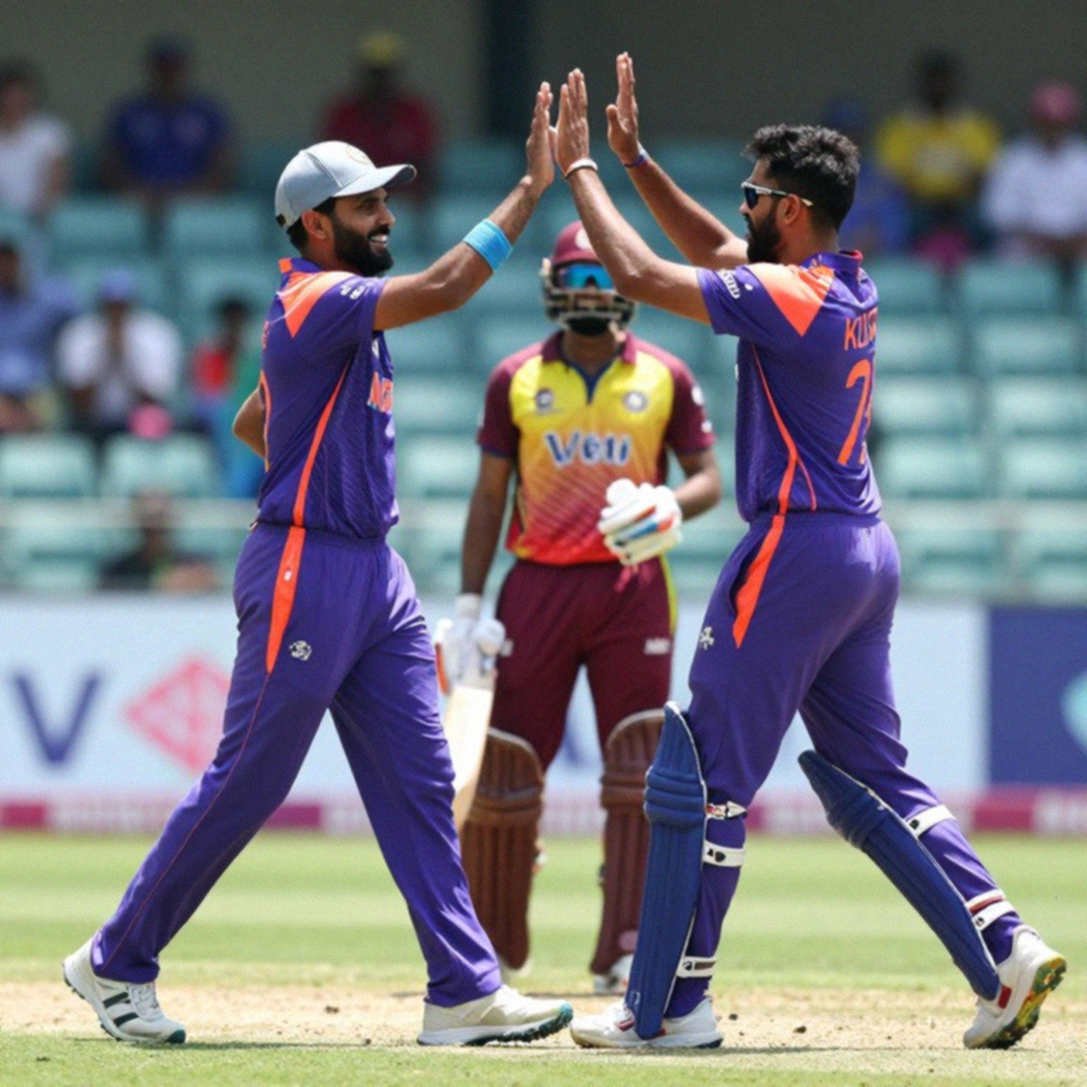
Two specialist keepers in a 15-man squad: Anvay Dravid and Rajat Baghel. Carrying two in a 14-day tournament is standard contingency, but it says more than that.
First, it hints at a heavy expected spin load, since keepers standing up to the stumps materially help spinners. Second, it signals a genuine like-for-like replacement rather than a part-timer — the team wants the keeping role protected against injury or loss of form.
Notably, the bowling discipline of several squad members — Kavya Patel, Mohit Ulva, Ishan Sood, Aryan Savsani — cannot be reconstructed from the names supplied. The pace-spin balance of the attack is therefore genuinely unknown; any claim about it would be guessing.
The Weight of Lineage: A Story Not About Cricket
The second paragraph of the announcement names the fathers of two squad members, both former India internationals. That is a deliberate editorial choice, and it will shape the entire public framing of this tournament in India.
Analytically it matters. Parentage has zero predictive validity for batting or bowling output. Assuming Aaryavir Sehwag is a top-order batter because his father opened for India is a narrative-based assumption, not analysis — his batting position and bowling utility are nowhere stated. By contrast, Anvay Dravid's role is explicit: wicket-keeper. That is the only confirmed fact about him in this announcement.
Equally telling: the actual subject of the headline, captain Raichandani, receives no analytical attention at all. Beyond his state and the fact that his captaincy was retained, the report offers nothing. That is the article's largest editorial imbalance.
Tournament Structure and the Group
Eight teams, two groups of four, top two advancing to the semifinals. India's Group A contains Nepal, Pakistan and hosts UAE.
The structure is forgiving: India can absorb one defeat and still qualify. But group position determines the semifinal draw, which makes the Pakistan fixture not just prestige but a directional marker.
Group A is effectively two-tiered. Pakistan is the only side with a comparable full-time junior pathway; Nepal are Asia's strongest associate at age-group level; UAE are hosts but structurally weakest. On paper India's qualification probability is high, with Pakistan the only genuine stress test.
One gap worth flagging: Group B composition is not disclosed in the source, so India's likely semifinal opponent cannot be projected from this material alone.
Venue and Conditions: Muscat's Low-bounce Surfaces
OCC Turf 1, Muscat — a neutral venue for all sides. Omani surfaces are typically low-bounce, slow and abrasive, generally assisting spin and cutters over express pace.
That marginally levels the gap between India and the associate sides, and it blunts Pakistan's principal edge: Pakistan's junior pathway has historically produced fast bowlers earlier than India's, but a low-bounce wicket neutralises much of that advantage.
November in Muscat is post-monsoon and comparatively mild, with humidity lower than in summer. Dew is a factor only in day-night fixtures, which the source does not specify. Pre-tournament DLS exposure therefore cannot be quantified. One caution: coastal Oman in November carries real Arabian Sea cyclonic activity risk, and a washout would affect net run rate and seeding.
The Opener Against Nepal: The Group's Highest-variance Fixture
India begin on November 6 against Nepal. On paper it is a straightforward fixture; analytically it is the group's riskiest.
Three reasons. It is a first game, so the side arrives rusty against the least-familiar opponent. Nepal are Asia's strongest associate at this level and increasingly produce players who graduate into franchise leagues. And a side with nothing to lose is always dangerous.
This is not a walkover. The one-change selection policy has a side-effect here: continuity reduces internal disruption, but it also reduces the element of surprise.
The Pakistan Fixture: The Only Genuine Test
The one group match where India can be put under real pressure — and the only fixture in this event with meaningful viewership outside India.
Politically it is significant. Bilateral India-Pakistan cricket has been frozen for over a decade; the two sides now meet only at ICC or ACC multi-lateral events. This match exists because of that structure, not because of bilateral relations, and a neutral Oman venue removes hosting and security disputes. As with the opener, one question precedes it: does India field its best XI, or rotate?
The Information Gap: What This Report Does Not Contain
This must be stated honestly. There is no batting average, strike rate, economy rate, recent score or situational split for any player in this material. At team level there is exactly one data point: a 3-0 Youth ODI series win over Australia.
The venue and conditions of that series are also unstated. If it was a home series, the neutral-venue Oman test is a genuine unknown.
The consequence: any assessment of any individual player right now is reputation-based, not evidence-based. At U19 level a 35+ average or a strike rate above 85 are the usual step-up thresholds, but there is no benchmark data here to compare against.
Risk: Calendar, Age Curve, Expectation
First, schedule load. A Youth ODI series against Australia in September-October, two Youth Tests, and a 14-day continental tournament in November form a dense three-month block for the same cohort. Multi-day cricket for 18-year-olds followed immediately by a 50-over tournament is a recognised soft-tissue and workload combination.
Second, small-sample volatility. At 17 to 19, performance variance is structurally high. One strong tournament inflates reputation far beyond underlying ability; one poor fortnight can prematurely close a pathway. Any evaluation needs at least a full season of domestic age-group data — Cooch Behar Trophy and Vinoo Mankad Trophy — which is absent here.
Third, expectation asymmetry. The realistic negative scenario is not India failing to qualify. It is India topping the group while the most-hyped teenager has a poor fortnight and carries a failure narrative at 17. That is a welfare risk, not a sporting one.
Fourth, the neutral venue compresses India's technical edge. Large-margin wins should not be priced in; net run rate may matter for seeding.
Governance: Age Verification and Monitoring Density
The highest-probability governance risk in any U19 event is age verification — documentation audit plus TW3 bone-age assessment. This report provides no date-of-birth certification or board verification. The absence of a red flag is not evidence of compliance.
Second, anti-corruption monitoring. Age-group and lower-tier events typically operate with thinner ACU presence, while betting markets on age-group internationals exist in some jurisdictions.
Third, selection transparency. Two of fifteen players are sons of prominent former internationals. Whatever the merit of the selections, Indian media will test this publicly; the board's best defence is transparent domestic age-group data, which is not furnished here.
Fourth, no ICC or national-board jurisdiction conflict is visible. The ACC is the correct sanctioning body, the BCCI the releasing board, and no government-interference, NOC or eligibility-switching issue arises.
Commerce and Industry: A Pipeline Signal, Not a Market Story
Direct broadcast-rights value here is low; ACC youth events are typically distributed through the council's own digital channels rather than sold as premium properties. No broadcast, sponsorship, ticket or rights data appears in the source, so no financial quantification is possible.
The real significance sits in the talent-supply chain. A well-run ACC U19 event is the cheapest available scouting market: eight teams, one venue cluster, two weeks, every player in a comparable competitive environment. The November window falls in a global lull for franchise leagues, raising the likelihood that overseas scouts and agents are physically present, though the source does not mention this.
One commercial premium is active: the lineage premium. A famous surname attracts media and sponsorship attention independently of output. That is traffic value, not sporting value, and the distinction is the heart of this story. Indian junior tournaments increasingly function as de facto IPL scouting combines, but conversion from U19 tournament performance to senior international success has historically been low to moderate — so that valuation deserves caution.
Narrative Velocity: Expectation Running Ahead of Fundamentals
The article's own structure is a signal: captain in the headline, two fathers in paragraph two, then the squad. That ordering is not incidental. It means most Indian coverage of this tournament will orbit those two teenagers rather than the captain or the competition.
The expectation gap, laid out: team results expectation is reasonable, since India have the strongest pathway in the group. Performance expectation for the lineage players is large and unjustified, since no data supports a projection either way. Public expectation of Raichandani sits below institutional expectation — the market is undervaluing him.
A hidden detail: naming the fathers before the full squad list is an editorial decision that will define the framing of the entire tournament. And because the event is in Oman rather than India, both teenagers will be physically insulated from the immediate media scrum while being digitally fully exposed — an unusual and arguably healthier combination than a home event.
Two Factual Cautions
First, the squad is labelled the ACC Men's U19 Asia Cup 2026 while the tournament window is stated as November 5-14 with a November 6 start. The year is internally inconsistent and must be verified against the official ACC/BCCI release before use; given the 'upcoming' framing, the most plausible reading is the imminent edition.
Second, all sixteen information points in the source carry blank attribution fields. No agency, journalist or board release is cited. Every fact should be treated as single-source and unverified until cross-checked against the BCCI junior selection committee's official communication.
What to Track
Raichandani's actual role and returns: scorecards from the Nepal and UAE fixtures will reveal his batting position and whether he bowls, determining whether the captaincy is a performance appointment or a leadership-only one.
Rotation policy in the group stage: resting first-choice players before the Pakistan fixture would indicate workload management and reveal the true first XI.
Pitch behaviour at OCC Turf 1: consistent first-innings totals below 230 would confirm spin-dominant conditions and reweight the pace-spin selection logic.
Lineage-player output against media volume: a large divergence in either direction would show how much of the narrative is fundamentals-driven.
Conclusion
This is a squad-announcement bulletin, not a story of analytical substance. Its genuine informational value is threefold: a format-specialised split-captaincy structure; a near-intact squad retained after a 3-0 Youth ODI sweep, indicating a stability-phase pathway; and India entering an eight-team ACC event in neutral Muscat as clear group favourites, with Pakistan the only genuine checkpoint.
The announcement's dominant public effect — attention on two players because of their fathers — is a purely narrative phenomenon with no evidentiary support in the source material. That distinction matters, especially when the weight of a continental tournament's expectations is being placed on teenagers. Sporting outcomes are highly uncertain; read the reasoning, not the hype.